

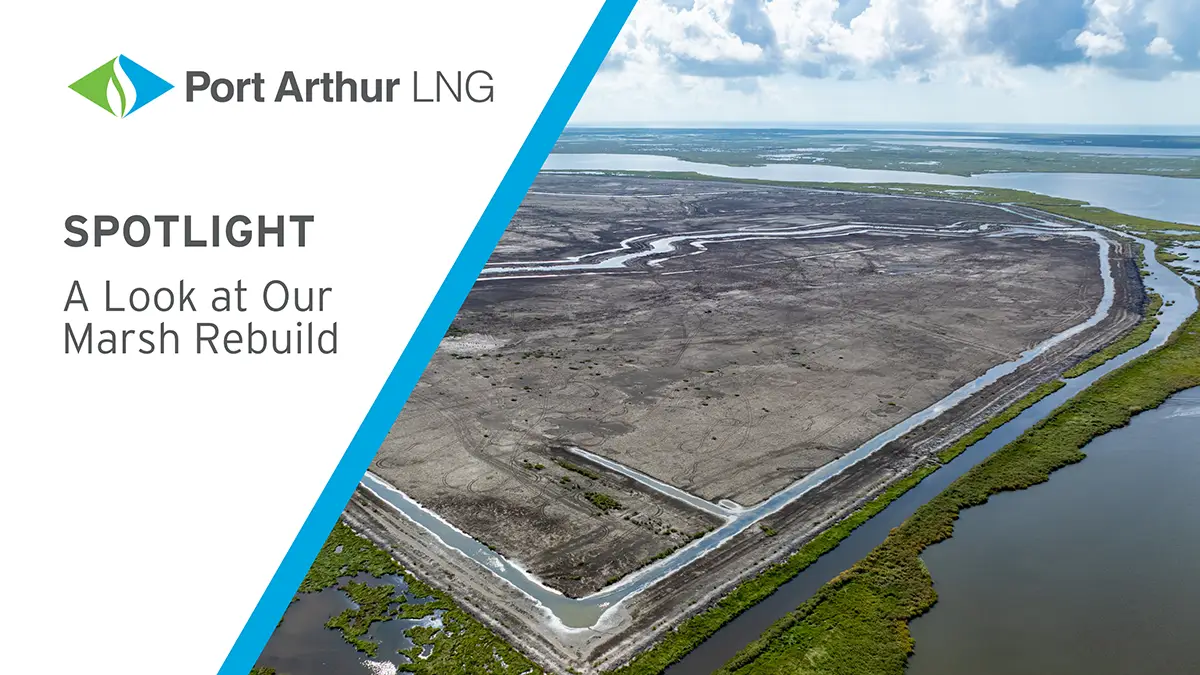
Along the Port Arthur Ship Channel in southeast Texas, Sempra Infrastructure is building Port Arthur LNG which is set to play a significant role in North America’s liquefied natural gas exports. As construction progresses, the company is also leading a major wetland restoration initiative for the Gulf Coast—demonstrating that responsible energy development and environmental stewardship can go hand in hand.
For decades, storms and hurricanes have eroded marshes along the Gulf Coast, weakening natural barriers that protect communities and wildlife. To help restore this critical ecosystem, Sempra Infrastructure is repurposing nearly two million cubic yards of sediment dredged from the project’s ship berthing areas, turning what would normally be considered a byproduct into a powerful tool for restoration.
Rather than discarding this nutrient-rich material, crews carefully pump it into nearby marshes at the J.D. Murphree Wildlife Management Area, gradually raising the land and replenishing soil lost over decades. As the sediment settles, it forms the foundation for new vegetation, helping to rebuild wetlands that sustain wildlife, improve water quality and provide natural protection against storms and flooding.
This initiative is a true collaboration, involving Sempra Infrastructure, the Texas Parks and Wildlife Department, J.D. Murphree Wildlife Management, STREAM Inc., Ducks Unlimited, Bechtel and its dredge subcontractor Great Lakes.
Together with these organizations, Sempra Infrastructure is helping rebuild more than 1,200 acres of marshland along the Gulf Coast, making it one of the largest projects of its kind in the region.
“For me, it’s an opportunity to demonstrate that impacts from industry don’t have to be a negative-sum action. When industry is willing to work with natural resource agencies, projects like this one can result in positive benefits for everyone,” said Jim Thompson, permitting and compliance manager for Sempra Infrastructure.
With the restoration already underway, sediment has been placed across much of the area, and Port Arthur LNG team members have begun reintroducing native grasses by hand. The work is labor-intensive, with each seedling carefully planted to ensure it takes root and thrives. Salt-meadow cordgrass, saltgrass and seashore paspalum were selected for their resilience and ability to coexist, creating a diverse and sustainable marsh. Additional planting is planned for summer 2026 to complete the full effort.
Over time, the restored marshland will balance 80% vegetation and 20% open water. It will serve as a vital nursery for shrimp, crabs and fish and support waterfowl and land-based wildlife, benefiting outdoor enthusiasts long connected to southeast Texas. In addition to boosting biodiversity and improving habitat quality, the marsh will help provide natural storm protection by buffering potential surges.
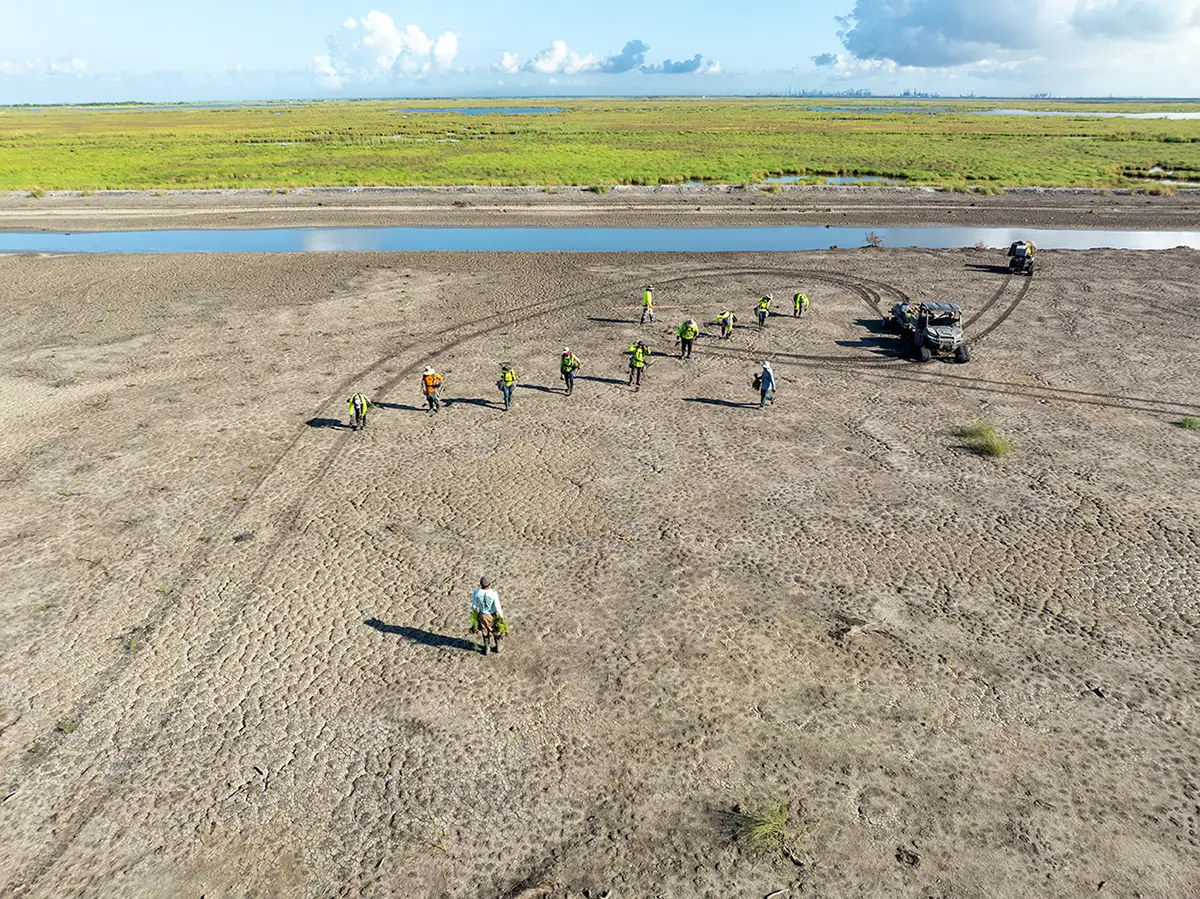
For those who call Southeast Texas home, the restoration carries personal meaning.
“I’ve grown up along the Texas Gulf Coast, and I have a deep appreciation for this region,” said Trevor Nailon, an environmental inspector on the project. “Being part of a project of this scale, one that benefits the local community and creates a space my family and I can enjoy for years to come through fishing and hunting—is incredibly meaningful to me.”
As Port Arthur LNG prepares to deliver energy to communities around the world, the restored marshes beside it stand as a living example of how critical infrastructure and environmental stewardship can advance together.
The work along the ship channel is helping fuel resilience, restore habitat and strengthen the coast, ensuring the Texas Gulf remains a place where people, industry and nature can thrive.
--------
This article contains forward-looking statements within the meaning of the Private Securities Litigation Reform Act of 1995. Forward-looking statements are based on assumptions about the future, involve risks and uncertainties, and are not guarantees. Future results may differ materially from those expressed or implied in any forward-looking statement. These forward-looking statements represent our estimates and assumptions only as of the date of this article. We assume no obligation to update or revise any forward-looking statement as a result of new information, future events or otherwise.
In this article, forward-looking statements can be identified by words such as “believe,” “expect,” “intend,” “anticipate,” “contemplate,” “plan,” “estimate,” “project,” “forecast,” “envision,” “should,” “could,” “would,” “will,” “confident,” “may,” “can,” “potential,” “possible,” “proposed,” “in process,” “construct,” “develop,” “opportunity,” “preliminary,” “initiative,” “target,” “outlook,” “optimistic,” “poised,” “positioned,” “maintain,” “continue,” “progress,” “advance,” “goal,” “aim,” “commit,” or similar expressions, or when we discuss our guidance, priorities, strategies, goals, vision, mission, projections, intentions or expectations.
Factors, among others, that could cause actual results and events to differ materially from those expressed or implied in any forward-looking statement include: decisions, audits, investigations, inquiries, regulations, denials or revocations of permits, consents, approvals or other authorizations, and other actions, including the failure to honor contracts and commitments, by the (i) U.S. Department of Energy, Comisión Nacional de Energía, U.S. Federal Energy Regulatory Commission, U.S. Internal Revenue Service and other regulatory bodies and (ii) U.S., Mexico and states, counties, cities and other jurisdictions therein and in other countries where we do business; the success of business development efforts, construction projects, acquisitions, divestitures and other significant transactions, including risks related to (i) being able to make a final investment decision, (ii) negotiating pricing and other terms in definitive contracts, (iii) completing construction projects or other transactions on schedule and budget, (iv) realizing anticipated benefits from any of these efforts if completed, (v) obtaining regulatory and other approvals and (vi) third parties honoring their contracts and commitments; changes to our capital expenditure plans and their potential impact on growth; changes, due to evolving economic, political and other factors, to (i) trade and other foreign policy, including the imposition of tariffs by the U.S. and foreign countries, and (ii) laws and regulations, including those related to tax and the energy industry in the U.S. and Mexico; litigation, arbitration, property disputes and other proceedings; cybersecurity threats, including by state and state-sponsored actors, of ransomware or other attacks on our systems or the systems of third parties with which we conduct business, including the energy grid or other energy infrastructure; the availability, uses, sufficiency, and cost of capital resources and our ability to borrow money or otherwise raise capital on favorable terms and meet our obligations, which can be affected by, among other things, (i) actions by credit rating agencies to downgrade our credit ratings or place those ratings on negative outlook, (ii) instability in the capital markets, and (iii) fluctuating interest rates and inflation; the impact on our ability to pass through higher costs to customers due to volatility in inflation, interest and foreign currency exchange rates and commodity prices and the imposition of tariffs; the impact of climate policies, laws, rules, regulations, trends and required disclosures, including actions to reduce or eliminate reliance on natural gas, the risk of nonrecovery for stranded assets, and uncertainty related to emerging technologies; weather, natural disasters, pandemics, accidents, equipment failures, explosions, terrorism, information system outages or other events, such as work stoppages, that disrupt our operations, damage our facilities or systems, cause the release of harmful materials or fires or subject us to liability for damages, fines and penalties, some of which may not be recoverable through insurance or may impact our ability to obtain satisfactory levels of affordable insurance; the availability of natural gas, including disruptions caused by failures in the pipeline and storage systems or limitations on the injection and withdrawal of natural gas from storage facilities; and other uncertainties, some of which are difficult to predict and beyond our control.
These risks and uncertainties are further discussed in the reports that Sempra has filed with the U.S. Securities and Exchange Commission (SEC). These reports are available through the EDGAR system free-of-charge on the SEC’s website, www.sec.gov, and on Sempra’s website, www.sempra.com. Investors should not rely unduly on any forward-looking statements.
Sempra Infrastructure and Sempra Infrastructure Partners are not the same company as San Diego Gas & Electric Company or Southern California Gas Company, and none of Sempra Infrastructure, Sempra Infrastructure Partners nor any of its subsidiaries is regulated by the California Public Utilities Commission.
